The Stamped blog
The Shopify Brand’s Guide to Reviews Platforms (2026)
Compare Stamped Reviews with Yotpo, Okendo, Judge.me, Klaviyo, Trustpilot, and Junip by getting an in-depth look at the features, pricing, and limitations of each platform.
Reviews
by Sammi Wong

High-performing ecommerce brands already know that reviews are key infrastructure in both customer acquisition and retention. They not only build trust and drive sales, but also offer behavioral signals and business intelligence that brands would otherwise have to pay for. 72% of people won’t make a purchase without reading at least one review, while photo reviews drive a 51% lift in AOV compared to text-only reviews.
With that kind of revenue on the line, picking the wrong platform isn’t just an inconvenience: it’s a risk to your conversion rates. Which reviews platform is the right fit for your brand?
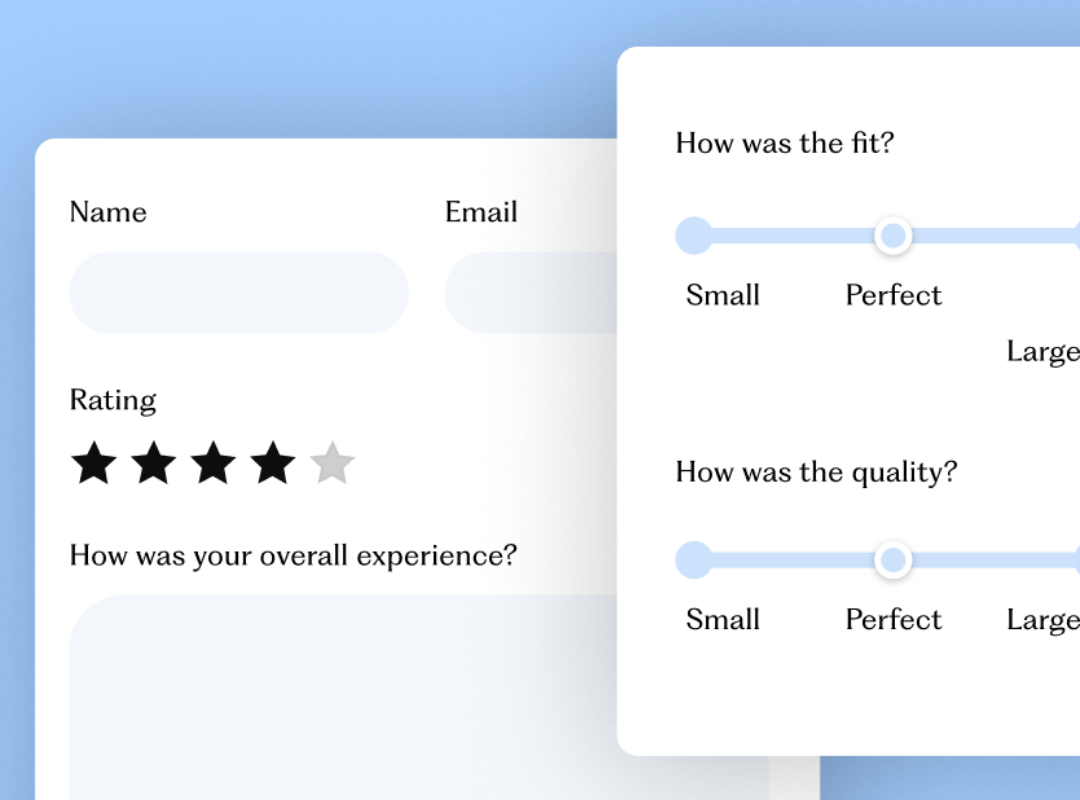
Reviews platforms at a glance
Pricing & Integrations
| Platform | Best for | Pricing (5K orders/mo) | Shop App | Meta | Bazaarvoice | Klaviyo | |
|---|---|---|---|---|---|---|---|
| Stamped | Shopify brands seeking growth-driving features | $199/mo | ✓ | ✓ | ✓ | ✓ | ✓ |
| Yotpo | Enterprise brands with complex needs | Custom quote | ✓ | ✓ | ✓ | ✓ | Partial |
| Okendo | Design-led enterprise brands | $499/mo | ✓ | ✓ | ✓ | ✓ | ✓ |
| Judge.me | Early-stage brands on a tight budget | Free or $15/mo | ✓ | No Seller Ratings | ✓ | ✗ | ✓ |
| Klaviyo | Brands fully embedded in Klaviyo | $500/mo | ✓ | No Seller Ratings | ✓ | ✗ | Native |
| Trustpilot | Brands prioritizing site-level credibility | Unclear (add-on) | ✗ | ✓ | ✗ | ✗ | ✗ |
| Junip | Mobile-first brands keeping it simple | Varies | ✓ | No Seller Ratings | ✓ | ✗ | ✓ |
Features
| Platform | Reviews | NPS | Incentives | Displays | Branding | Q&A | Analysis |
|---|---|---|---|---|---|---|---|
| Stamped | ✓ | ✓ | ✓ | ✓ | ✓ | ✓ | ✓ |
| Yotpo | ✓ | ✓ | No UGC incentives | ✓ | ✓ | ✓ | ✓ |
| Okendo | ✓ | ✓ | ✓ | ✓ | ✓ | ✓ | ✓ |
| Judge.me | ✓ | ✗ | No incentive caps | ✓ | ✓ | ✓ | Limited |
| Klaviyo Reviews | ✓ | ✗ | No incentive caps | No galleries | ✓ | ✓ | Limited |
| Trustpilot | Add-on | ✓ | ✗ | ✓ | No whitelabeling | No user Q&A | ✗ |
| Junip | One request only | ✗ | No incentive caps | CSS requires API | No whitelabeling | ✗ | ✓ |
Yotpo: built for enterprise
Yotpo has the name recognition and reputation, and it’s earned. It’s a mature platform with a wide feature set covering product reviews, photo and video UGC, custom questions, Q&A, and NPS. If you’re evaluating platforms, Yotpo is likely already on your shortlist.
The catch: it’s designed around enterprise brands and the budget that comes with it. Custom pricing starts at 5,000 orders and requires a quote, which means if you’re at $5M in revenue and growing, you’re often paying for infrastructure meant for a brand five times your size. Not all features are available on all plans, so you may end up paying for more than your order volume requires just to get access.
The integration limitations also show up fast for Shopify brands running a modern stack. Yotpo doesn’t support review events as Klaviyo flow triggers, so if you want to send a personalized campaign when a customer submits a 5-star photo review, that’s not an option. They also don’t offer Postscript and ActiveCampaign integrations.
Lastly, there’s no option for separate incentives for media reviews. Offering a 10% coupon for text reviews and a 15% coupon for photo reviews can make all the difference. Without it, customers are less motivated to include UGC in their review.
How Stamped compares: Pricing is publicly listed, and custom pricing doesn’t start until 20,000 orders, making it easy to get started without needing a sales demo. All features are available on all plans*, so brands pay based solely on order volume. We also have Postscript and ActiveCampaign integrations, and review events are available as Klaviyo flow triggers, making it easy to fire personalized review follow-ups (visit our Plays Library for examples). Brands also have the option to set different incentives for different types of reviews, improving collection rates for photos & videos.
Yotpo is best for: Enterprise brands with high order volumes, generous budgets, and a dedicated ops team to manage them.
Okendo: design-led, at a price
Okendo is a great choice for brands where aesthetics are non-negotiable. The widgets are polished, and the platform covers the core reviews features that matter: photo and video reviews, AI-suggested review topics for guided collection, custom questions, and sentiment analysis. If widget design is a key decision factor for you, Okendo is likely to win.
The pricing is where the math gets harder. At 5,000 monthly orders, Okendo Reviews is $499/mo, more than double Stamped’s $199/mo at the same order volume. Like Yotpo, not all features are available on all plans, so you may end up paying for more than your actual volume requires. Some plans require contracts, meaning you’re locked in even if the platform doesn’t end up working out.
There are also a few feature gaps worth knowing: if you’re looking for reviews and loyalty on the same platform, Okendo’s Loyalty and Referrals are two separate products with their own costs. Okendo’s Reviews also asks you to choose between discount codes or loyalty points in exchange for reviews. Lastly, Okendo doesn’t have the option to manage Q&A in Gorgias, creating a disconnect between your reviews and your help desk.
How Stamped compares: Stamped covers the same core feature set (UGC reviews, Smart Assist, custom questions, and sentiment analysis) at less than half the price at comparable order volumes, with all features on all plans* and no contracts. Stamped’s Loyalty includes referrals, so you’d only be paying for two products, not three. Review incentives aren’t binary; you can offer discount codes and loyalty points simultaneously. We also integrate with Gorgias to help you seamlessly manage and reply to reviews and Q&A in your help desk.
Okendo is best for: Design-forward enterprise brands for whom aesthetics justify the price premium.
Judge.me: budget-friendly starter
Judge.me is the obvious entry point for brands just getting their reviews program off the ground. The pricing is genuinely accessible at $15/mo, the Shopify setup is fast, and for a brand with a handful of SKUs and modest order volume, it does the job.
The feature ceiling becomes clear at scale. Judge.me isn’t a certified Google reviews partner, which means no Google Seller Ratings, a meaningful gap when you’re competing for clicks in Google Shopping or running paid ads. There’s no sentiment analysis, no Bazaarvoice syndication, and no Attentive or Postscript integration for SMS-based review collection.
There’s also no cap on review incentives, which sounds fine until you’ve accidentally discounted your way through a month’s margin trying to hit a review target. The reporting is limited enough that you’re largely guessing at which products are underperforming on reviews and why.
How Stamped compares: Stamped is a certified Google reviews partner, so your reviews sync to Google Product and Seller Ratings, a direct lever for paid efficiency and organic click-through. Sentiment and topic analysis are included on all plans, so you can identify which products are generating negative reviews and why without needing to manually export or analyze your data. Bazaarvoice syndication lets you push reviews to retail marketplaces, increasing traffic and conversions. Incentive controls let you limit the number of discounts per customer to protect your margins. And finally, customer-level reporting gives you visibility into review behavior beyond basic aggregate counts.
Judge.me is best for: Early-stage brands and lean teams who need a functional reviews setup without the overhead.
Klaviyo Reviews: convenient, not complete
If your entire marketing stack runs through Klaviyo and you want the path of least resistance for review collection, Klaviyo Reviews makes sense. One fewer integration to manage, with review requests sent natively through the platform you already know inside and out.
However, the feature gaps are noticeable. Klaviyo’s in-email review form doesn’t support custom questions or photo submissions, and it can’t be meaningfully customized in design. There are no galleries, pop-up widgets, or side drawers for on-site displays, significantly decreasing the chances of reviews being seen and driving conversions. And similar to Judge.me, there are no options for limiting review incentives, risking over-discounting and cutting into your margins.
Additionally, Klaviyo doesn’t integrate with Google Seller Ratings or syndicate with Bazaarvoice. Their reviews analytics aren’t especially thorough. At 5,000 monthly orders, Klaviyo Reviews costs $500/mo, $301 more per month than Stamped for considerably fewer features. The convenience is genuine, but so is the trade-off.
How Stamped compares: Stamped and Klaviyo are designed to work together, not compete. Stamped’s review requests can actually be sent through Klaviyo, keeping your emails on-brand and your performance data in one place. Here’s what Stamped adds on top: custom questions and media submissions in the in-email form, display widgets, Google Seller Ratings for paid ad strategies, Bazaarvoice syndication for driving traffic and sales, exclusion and limitation options, and review-specific analytics. That’s $301/mo less for a platform purpose-built around reviews.
Klaviyo Reviews is best for: Brands deeply embedded in Klaviyo who want a simple, familiar reviews setup and can live with the feature limitations.
Trustpilot: site reviews, full stop
Trustpilot is a credibility play, not a product reviews platform. Its core purpose is to collect and displays site reviews with the brand recognition that consumers broadly trust. If your goal is a “Trustpilot Verified” badge on your homepage and you’re in a category where brand-level credibility matters more than product-level social proof, such as professional services, B2B, and high-consideration purchases, then Trustpilot might make the most sense.
For most Shopify brands, the model doesn’t fit. Trustpilot’s product reviews are an add-on with no transparent pricing. Unverified reviews are reportedly impossible to challenge and remove. Widget customization is minimal and doesn’t support CSS. There’s no in-email reviews form, no review incentives, no community Q&A, and only one type of custom question (five-point scales, which are useful for overall analysis but not for collecting unique anecdotes).
Trustpilot’s logo is visible in all of your messaging and widgets regardless of plan, which may actually be preferable for some brands but invasive for others. Core integrations that most Shopify stacks depend on like Bazaarvoice, Attentive, Gorgias, Postscript, and Meta aren’t available. There are no customer profiles and no options to export reviews data for reporting or analysis. While Trustpilot has strong brand recognition, that recognition doesn’t necessarily translate into the product-level social proof that drives purchase decisions.
How Stamped compares: Stamped collects both product-level and site-level reviews natively: no add-ons, no opaque pricing tiers. Review moderation makes it easy to challenge false or inflammatory reviews without compromising brand honesty. Widget customization supports full CSS and white-labeling so your branding stays your own. Stamped’s in-email reviews form, review incentive options, community Q&A, and multiple custom question types makes collecting insights easier for you and your customers.
You can also export your data to build reports and analyze performance without hitting a wall. Bazaarvoice, Attentive, Gorgias, Postscript, and Meta integrations are all available. For Shopify brands, product reviews are where purchase decisions actually happen, and Stamped is built around that reality.
Trustpilot is best for: Brands where site-level credibility is the primary objective, particularly in B2B or high-consideration categories.
Junip: mobile-first, feature-light
Junip has built a clean, mobile-optimized review experience. For brands where a significant share of purchases come through mobile, a reality for many Shopify brands today, a well-designed mobile submission flow genuinely matters. Junip integrates with Klaviyo and Attentive, covers photo and video reviews, and has a straightforward setup experience.
The trade-offs stack up at growth stage. Review request sequences are limited to just one email. There’s no Q&A, no Bazaarvoice syndication, and no integration with Google Seller Ratings. Junip’s branding appears on all emails and display widgets on every plan, a friction point when you’re building a seamless brand experience. Custom CSS requires using Junip’s API, and the main reviews widget doesn’t offer as many filtering options as customers may expect, creating additional friction in the product research stage.
Reporting is relatively limited with no customer profiles. Review incentive controls lack the guardrails that prevent over-discounting, and there are no separate options for incentivizing photo & video reviews. And finally, not all features are available on all plans.
How Stamped compares: All features are available on all plans*, so pricing is based solely on monthly order volume. Stamped’s review request sequence allows for multiple emails to maximize chances of conversion and offers incentive controls that help you structure discounts by review type and set limitations to protect your margins. Our brand and community Q&A handles common pre-purchase questions directly on the PDP and reduces support ticket volume. White-labeling is available on all paid plans, with no Stamped branding on your emails or widgets and no API or developer support required. Google Seller Ratings and Bazaarvoice syndication are included, and our integration library extends to Recharge, Gatsby, Tapcart, and more.
Junip is best for: Mobile-first brands in the earlier stages of building their reviews strategy.
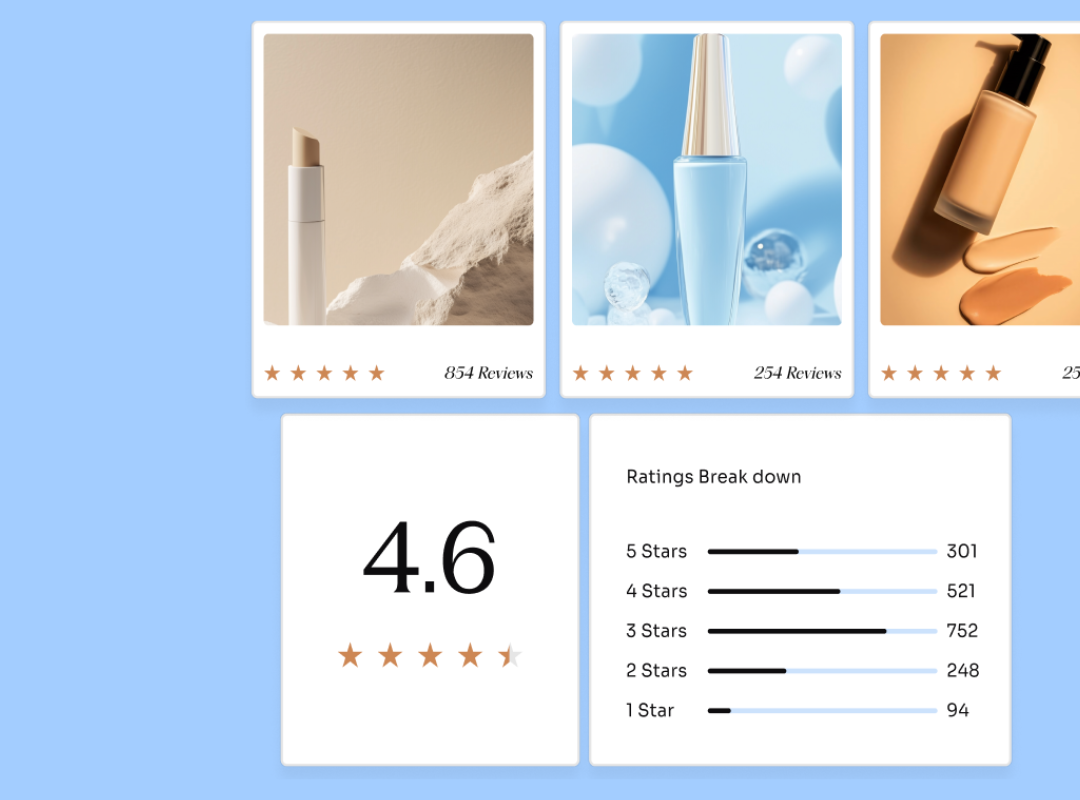
Stamped: built for growth
Stamped is designed for Shopify brands that want more from their reviews than just an aggregate star rating sitting on their PDPs, but a complete system for driving customer acquisition, retention, and business intelligence. Our features covers the full stack: product reviews, photo and video UGC, in-email submission forms, NPS, customer Q&A, smart incentives with discount controls, Smart Assist for guided collection, sentiment and topic analysis, and review-attributed revenue tracking.
All features are available on all plans*, with pricing starting at $23/mo for 200 orders and scaling to $199/mo at 5,000 orders. No contracts and no custom quotes until you hit 20,000+ orders, making it easy to get started and scale as your business grows.
The Klaviyo integration goes deeper than most: you can send review requests via Klaviyo to keep your emails fully on-brand, and use review activity as event triggers in your flows. Stamped is a certified Google reviews partner with syndication to Google Product and Seller Ratings, as well as Facebook Shops, Instagram Shops, and Shop App. Lastly, our Bazaarvoice syndication is included for brands selling through major retail marketplaces like Walmart and Target.
Stamped is best for: Shopify brands starting at $1M GMV who want a full-featured reviews platform with transparent pricing, strong integrations, and room to expand.
*All Stamped features are available on all plans except for the Bazaarvoice integration. Brands must be paying at least $199/mo to gain access.
What moves review program performance
What are the five things that actually drive review program performance? To summarize our comparison, this is what Stamped delivers:
- In-email review submission: Stamped’s in-email form averages a 6.5% review collection rate; top brands hit 20%+. External form links from other providers frequently drop below 1%. That gap compounds fast across 5,000+ orders a month.
- AI Insights available on every plan: Topic and sentiment analysis show you exactly what customers love or hate, organized by product and theme, without needing to export spreadsheets or open ChatGPT. It’s not a paid add-on or limited to specific plans.
- Limitations and exclusions that just make sense: Letting customers have free rein to leave reviews or collect discounts can be bad for business. Set limits that stop them from reviewing samples and shipping protections or racking up 20% off discounts.
- Distribution that drives traffic and efficiency: Google Product and Seller Ratings, Shop App syndication, Bazaarvoice syndication, and Facebook & Instagram Shops syndication — all native, not partner or developer-dependent.
- Transparent pricing at every tier: Plans are publicly listed, no contracts or annual lock-ins required, and are typically lower than Yotpo, Okendo, and Klaviyo Reviews above 3,500 orders/month.
How Stamped supports Shopify brands
Here are some examples of brands using Stamped Reviews today:
- Kingdom Kratom: ~30x increase in review submission conversion after migrating from Judge.me, going from 12 reviews/month to 600.
- Inno Supps: 51% lift in AOV for customers exposed to reviews collected through Stamped, driven by 5,000+ photo reviews collected.
- Park Seed: 900+ customer questions resolved through Q&A, reducing support ticket volume and improving PDP conversion.
- Every Man Jack: 15% lift in review collection volume after switching to Stamped’s review request cadence and integrating with Attentive.
- Moonglow Jewelry: 7% review conversion rate and hundreds of actionable insights into brand, product, and logistics improvements.
All of our case studies are available here, or check out our Reviews Benchmark Report to see how the average brand performs with Stamped Reviews.
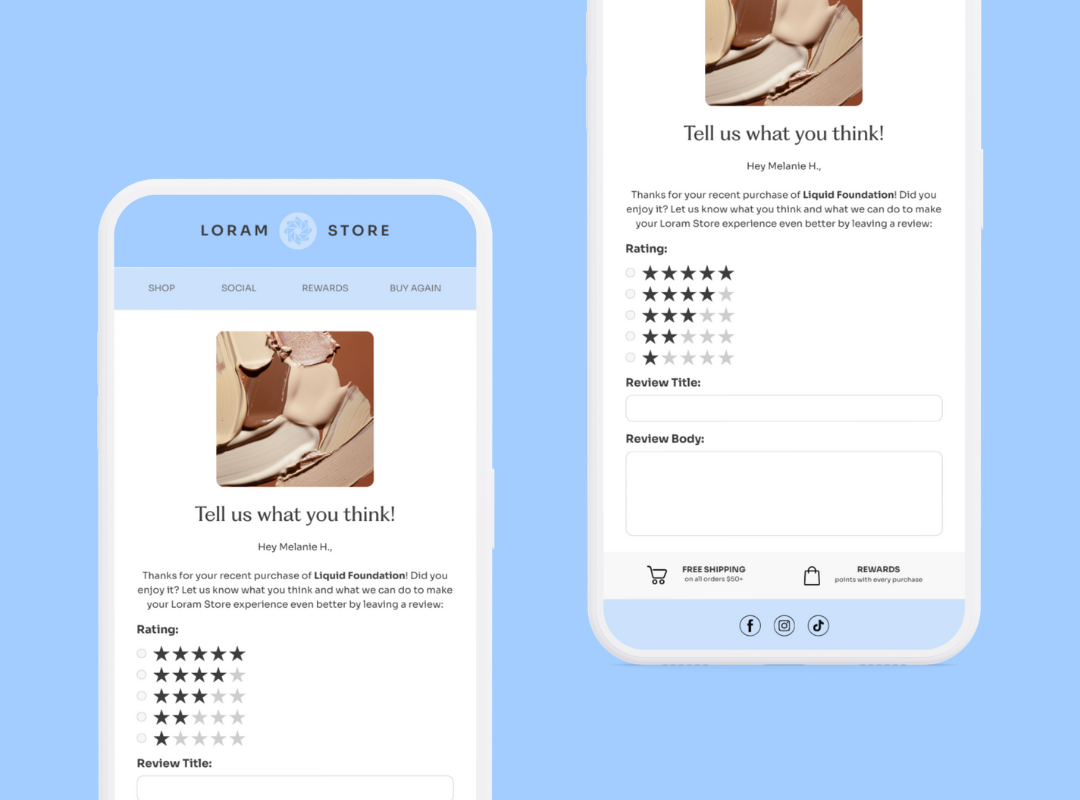
What to ask in your next demo
When evaluating different reviews platforms, here are five questions to consider that help you separate the sales demo from the operational reality.
- Request a live demonstration of the in-email review submission: Confirm whether it’s a true in-email form or a link to a separate webpage. The difference can be 6x in collection rate vs. hundreds of missed insights.
- Ask for monthly pricing at your current order volume and 2x your current volume: Note any platform that won’t quote in writing or only offers annual contracts, and make sure the pricing scales with your business’s growth.
- Confirm the availability depth of their Klaviyo integration: Do they offer review events, sentiment scores, and custom segments, or just a one-way push? This goes for any ESP provider, but bonus if they offer Klaviyo review requests.
- Get specific about limitations and exclusions: Many platforms lack the option to exclude specific customers or products, or to limit unverified reviews or the number of incentives, leading to fake testimonials and over-discounting.
- If syndication matters: Confirm Google, Shop App, Bazaarvoice, and Meta are native integrations and don’t require API or developer assistance. You’ll also want to make sure the Shop App syndication works in both directions.
Any vendor that openly answers these questions and meets your brand’s specific needs is one that you can trust and build a long-term reviews program on. Stamped’s goal is to help brands turn customer reviews into powerful social proof and actionable business intelligence for driving sales. Get started with Stamped →
Related Articles

Why Most Ecommerce Brands Underuse Their Review Data
Most brands misunderstand the full scope of what reviews are, and more importantly, what they can tell you. Reviews aren't a conversion optimization tactic—they're actually a continuous stream of customer intelligence. Here's why brands miss out on the crucial data layer in their reviews.
by Aiden Brady
Customer Insights
Reviews

How Smart Brands Turn Reviews Into Business Intelligence
Let's break down the misunderstood truths about reviews and what smart brands do differently.
by Aiden Brady
Reviews

Growth Hacking Reviews & Loyalty
Missed our DTCx webinar? Watch the recording and discover proven growth hacks to amplify your reviews, boost loyalty, and drive revenue for your eCommerce brand.
by Teala Beischer
Loyalty
Reviews